
1. Market Chaos: The number of new entrants to the Mexican automotive industry has surged, with over a dozen Chinese brands making a strong entry. Brands such as Omoda, Chirey, Jetour, and Great Wall Motors have entered the Mexican market, creating new competition with established players.
2. Huge Market Share: Chinese-made cars currently hold a significant share of the Mexican market. According to a report by Mexico’s National Institute of Statistics and Economic Studies (INEGI), approximately 20% of all new cars sold in Mexico bear the “Made in China” label, meaning that two out of every ten cars are made in China.
3. Global Manufacturing Powerhouse: China’s rise in the automotive industry extends far beyond Mexico’s borders. In 2012, China surpassed the United States to become the world’s largest automaker. Initially, this massive production capacity primarily met domestic demand, but due to China’s ability to scale up production and its competitive manufacturing costs, its global footprint has expanded significantly.
4. Global Manufacturing Powerhouse: China’s rise in the automotive industry extends far beyond Mexico’s borders. In 2012, China surpassed the United States to become the world’s largest automaker. Initially, this massive production capacity primarily served domestic demand, but its global footprint has expanded significantly due to China’s ability to scale up car production and its competitive manufacturing costs.
5. Dominance in Electric Vehicles: As the global automotive industry transitions to electric vehicles (EVs), China has achieved dominance. Last year, China accounted for approximately 70% of global EV production, solidifying its leading position in the EV sector. In Mexico, affordable EVs produced by Chinese manufacturers, such as the E-WAN Cross and JAC E10X, are gaining popularity.
6. Supply Chain Resilience: The pandemic highlighted China’s resilience in the face of supply chain disruptions. While other regions struggled with semiconductor shortages, China rebounded quickly, underscoring its crucial role in the global automotive supply chain.
—
Mexico’s Nearshore Outsourcing: Nearshore outsourcing is a strategy in which companies move all or part of their production closer to the end consumer, thereby reducing costs and avoiding logistical setbacks. In recent years, many businesses around the world have begun to adopt it as an alternative, primarily to avoid supply chain issues. But what triggered nearshore outsourcing?
– US Tariffs on China
The tariffs imposed by the US in 2018 led some companies to seek alternative markets to reduce costs.
– North American Free Trade Agreement (NAFTA) and the United States-Mexico-Canada Free Trade Agreement (USMCA) (2020)
The USMCA raised the regional value content requirements for products to be considered North American-made, incentivizing manufacturers to relocate supply chains.
– COVID-19
The rapid spread of COVID-19 led to global border closures, impacting the supply and delivery times of goods as demand for various products increased.
– Logistics Disruptions
Increased supply and transportation costs of containers, particularly ocean freight, increased transportation costs by over 500%.
– The Russia-Ukraine War
The outbreak of the war in Ukraine restricted the supply of raw materials, forcing global companies to seek alternative suppliers.
Mexican Opportunities.
For Mexico, these developments are seen as a once-in-a-lifetime opportunity – capable of driving economic growth across all sectors of the Mexican economy. In fact, nearshore outsourcing could help Mexico increase its GDP by 3% over the next five years.
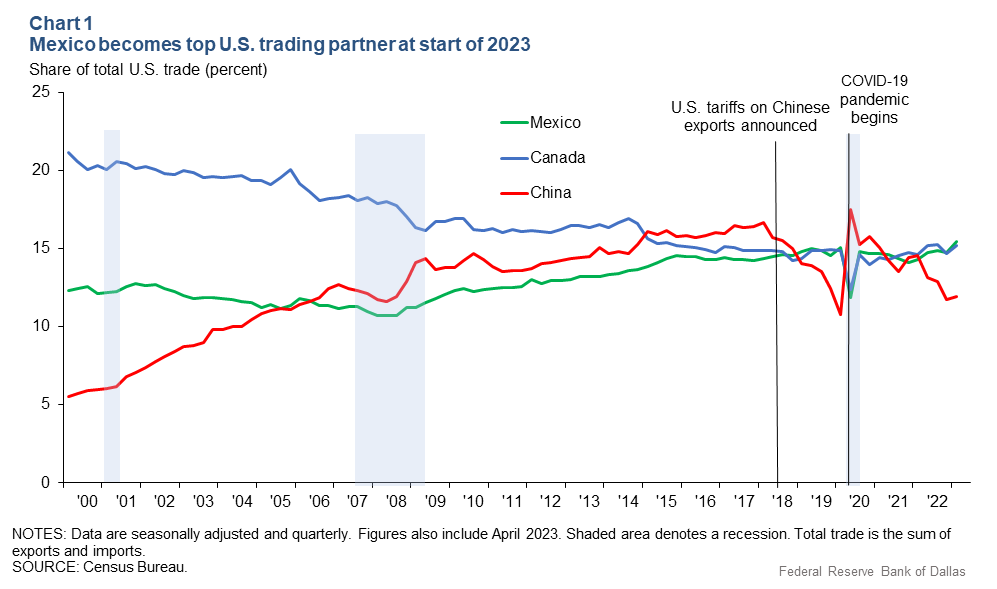
Mexico has begun to capitalize on this opportunity. According to a survey by the Central Bank of Mexico, nearshore outsourcing is starting to materialize. However, business opinions suggest that the impact of nearshore outsourcing will be gradual, not felt until after 2024.
Foreign Direct Investment in Mexico
Nearshore outsourcing has not yet led to a significant increase in Mexico’s foreign direct investment (FDI), as evidenced by the fact that FDI levels before and after the pandemic were almost identical. However, some trends suggest this may change. For example, in 2022, new investment accounted for 48% of total FDI in Mexico, the highest level since 2013.
Where is the investment coming from?
According to our analysis, two main groups are reallocating their investments to Mexico. The first is US companies already operating in Mexico and currently expanding their capacity. The second is Chinese companies (including not only mainland China but also Hong Kong and Taiwan) seeking the benefits of production in North America while avoiding high labor costs and reducing the risk of supply chain disruptions.
Sectors Attracting Foreign Direct Investment in Mexico
While transportation equipment remains the leading sector for FDI in Mexico, other sectors, such as electrical components and appliances, and communications and computer equipment, have also attracted investor attention in recent years. Given the logistical challenges many in these sectors faced during the pandemic, this increase in FDI may simply be a transfer of capital.
Mexican Manufacturing Booms
Increased global market demand has led to accelerated production in Mexico’s manufacturing sector. In 2022, Mexico’s manufacturing sector grew at an annual rate of 5.2%, significantly higher than the average growth rate of the previous 10 years (+2.3%).
Mexico’s proximity to the United States and its close free trade ties make it a particularly attractive investment destination for the US market. US FDI in Mexico’s automotive and electronics sectors has benefited from the decline in FDI from China. In 2021, US companies invested more in Mexico than in China. This year, Tesla is embarking on construction of a $5 billion Gigafactory in Monterrey, Mexico, primarily producing electric vehicles and clean technology products.
According to official data, Chinese investment in Mexico (primarily concentrated in the automotive and electronics sectors) reached $151 million in 2022. This is likely a significant underestimate. Management consulting firm Kearney, in its 2022 Reshoring Index, points out that “US and Mexican sanctuary companies” obscure the ultimate source of invested capital. Industrial parks in border cities like Tijuana, Juarez, and Monterrey are teeming with Chinese manufacturers and their suppliers.